

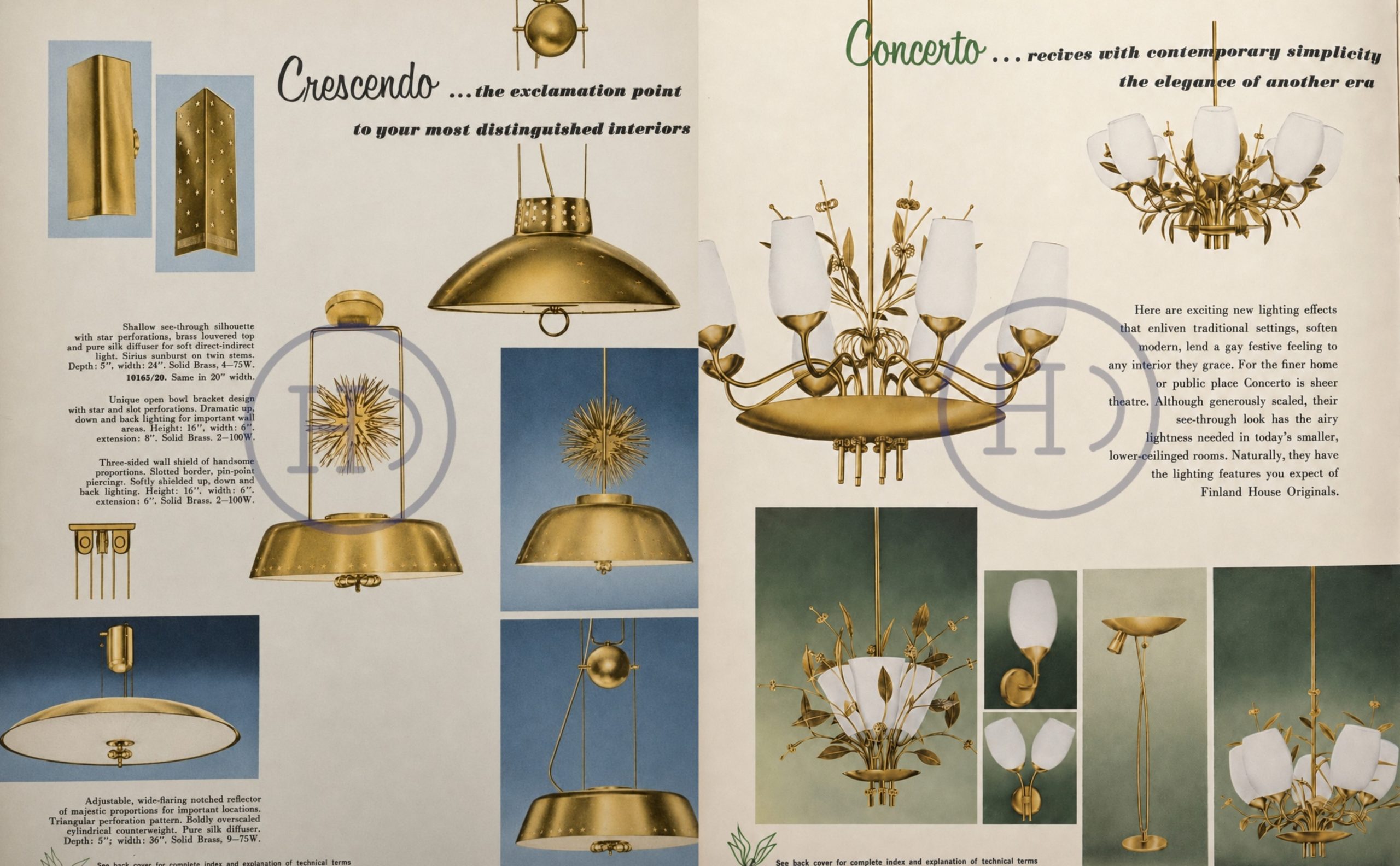
“Harmony in lighting, for harmony in living”

In the postwar years, Finland House New York, the retailer of Paavo Tynell lamps and Finnish Design, did not just sell lighting fixtures and modern Finnish aesthetics to the American market. It sold atmosphere, orchestration, and the idea that modern interiors could be composed with the same emotional precision as music.
The language of the catalogue makes this immediately clear.
Rather than organizing fixtures by utility or room type alone, Paavo Tynell introduced collections named Crescendo, Concerto, Sonata, Humoresque, Fantasia, and Allegro. These were not simply product groupings. They were tonal movements within a larger compositional system. It was a symphony of light intended to shape how modern interiors were experienced emotionally and spatially.
What is particularly striking today is that the main Finland house catalogue was not primarily directed toward everyday consumers and end users. Its audience was architects, interior designers, decorators, and lighting engineers. The catalogue repeatedly emphasizes consultation, coordinated planning, custom solutions, and integration across entire installations. Finland House understood that Tynell’s lighting was too sophisticated to be reduced to isolated decorative objects. These were instruments within a carefully orchestrated architectural environment.
Seen through this lens, the catalogue becomes less a sales brochure and more a manifesto for total interior lighting design.
The catalogue’s slogan — “Harmony in lighting for harmony in living” — establishes the conceptual framework immediately. Finland House presents light not as a technical necessity, but as a compositional force capable of transforming architecture, mood, scale, and human experience.
The musical naming system reinforces this idea throughout the catalogue:
- Crescendo introduces drama and visual climax.
- Concerto blends elegance and tradition with modern simplicity.
- Fantasia creates movement, whimsy, and spectacle.
- Sonata softens interiors with lyrical calmness.
- Humoresque introduces warmth, texture, and informality.
- Allegro captures youthful modern energy.
Each collection functions like a movement within a larger interior composition.
This was a remarkably sophisticated marketing strategy for the American market of the 1950s. Rather than explaining modern lighting through engineering terminology alone, Finland House translated Scandinavian modernism into emotional and cultural language that architects and designers could communicate to clients.
The fixtures themselves became atmospheric tools.
Crescendo: The Dramatic Opening Movement
The Crescendo collection was presented as “the exclamation point to your most distinguished interiors,” and the language is intentionally theatrical. Large perforated brass reflectors, suspended counterweights, starburst motifs, and dramatic silhouettes dominate these pages. Many fixtures incorporate direct-indirect lighting systems, perforated brass, or adjustable counterbalanced mechanisms that allowed lighting conditions, just like music, to be fine-tuned within a space.
These were not passive fixtures. They actively shaped the room around them.
The emphasis on adaptability is especially important. Finland House repeatedly highlights adjustable heights, directional control, flexible mounting, and layered illumination. This reveals how deeply the company understood the needs of architects and designers. Tynell’s lighting was not simply decorative sculpture. It was integrated environmental design.
Concerto: Bridging Tradition and Modernity
If Crescendo introduced drama, Concerto offered reconciliation. The catalogue describes the collection as reviving “the elegance of another era” with “contemporary simplicity.” Floral references, opal glass, delicate brass leaves, and chandelier forms softened the transition into modern interiors for American audiences still attached to traditional decorative schemes. The iconic bridal bouquet series belongs to this group and is just an example how part of Tynell’s genius lied in his ability to modernize without eliminating warmth or ornament.

Fantasia: Kinetic Light and Decorative Performance
The Fantasia pages are among the most extraordinary in the catalogue. Snowflake sculptures, suspended brass elements, pierced reflectors, and delicate balancing systems transform light fixtures into moving compositions.
These designs occupy a fascinating space between lighting, sculpture, and theatrical installation and the went on to become classics sought by collectors and decorators and depicted on magazine covers like the cover of the Bride’s magazine from 1953 shown below.

Sonata: The Architecture of Softness
The Sonata section may be the clearest articulation of Finland House’s understanding of emotional lighting. Descriptions repeatedly reference moonlight, softness, glare-filtered illumination, visual comfort, and enlarged spatial perception. The collection uplifts and brings forward one of Finland’s oldest and most established industries, glass blowing.
This was modernism made psychologically comfortable.

Humoresque: Texture, Nature, and Scandinavian Warmth
The Humoresque collection introduced another essential dimension of Scandinavian modernism to the American market: tactility and organic materials. Rye straw, aspen slats, woven shades, and textured natural materials appear throughout these designs. Finland House carefully framed these natural elements as luxurious rather than rustic.
Allegro: Young America and the Future of Modern Living
By the time the catalogue reaches Allegro, the language changes noticeably. The collection is described as capturing “the vibrant spirit of Young America.”
This is perhaps the clearest moment where Finland House fully adapts Scandinavian modernism to the aspirations of postwar American life. It is described as a collection resulting from Paavo Tynell’s trip to the U.S. where he made an intensive and personal study of the clients’ needs and preferences. Aimed to make small areas larger and engineered for functional utility and peak lighting efficiency.

Beyond the Musical Movements
Importantly, the catalogue did not limit itself to the six named collections. After these thematic “movements,” Finland House expanded the presentation into a broader technical and architectural system that included pendant designs, adjustable fixtures, multiple-light compositions, surface-mounted models, wall-mounted lighting, and portable lamps. The progression into these latter categories will be the subject of an upcoming blog, but for this one, I wanted to share how Tynell’s work presented a complete orchestral language for modern interiors. Each collection represented a different emotional register and contributed to a larger spatial composition. Architects and designers were invited not simply to purchase lamps, but to conduct atmospheres.
This was Finnish modernism translated for postwar America with remarkable sophistication: warm rather than austere, emotional rather than mechanical, adaptable rather than rigid, and deeply integrated into architectural life.
In the end, the catalogue’s slogan proves entirely accurate. Tynell’s lighting was never only about illumination. It was about harmony.
Paavo Tynell’s international success was built on a rich tradition of Finnish craftsmanship. Discover how Nikolai Boman and his family helped lay the foundations of Finland’s furniture industry in our related article “The Forgotten Dynasty of Finnish Design“.
All images except for the Bride’s Magazine are colorized extracts from the Finland House Lighting Catalogue.
Author: Shadi Haddadin
