

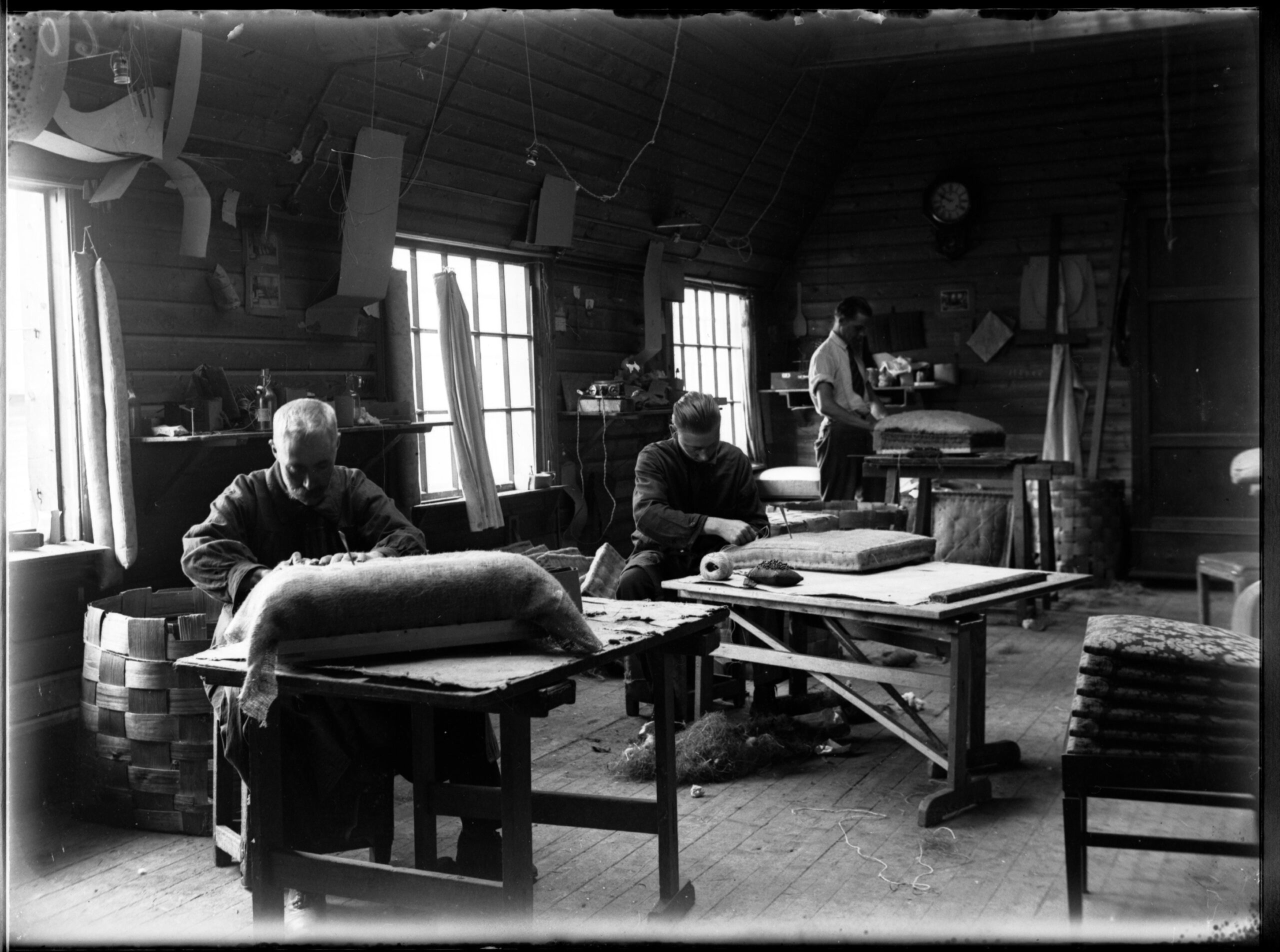
The Forgotten Dynasty of Finnish Design
How Nikolai Boman and His Sons Helped Build Finland’s Furniture Industry
When discussing the pioneers of Finnish design, names such as Alvar Aalto, Paavo Tynell, Tapio Wirkkala, and Eero Aarnio naturally come to mind. Yet long before these figures achieved international fame, another family had already laid much of the foundation upon which the success of Finnish design would later be built on.
Their name was Boman.
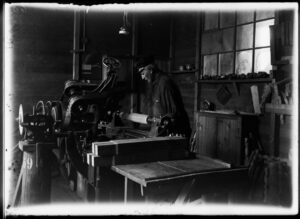
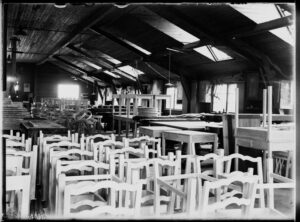
For nearly a century, the Boman family stood at the center of Finnish furniture production. Their workshops furnished churches, banks, hotels, schools, government buildings, private residences, and even palaces abroad. Their factories employed hundreds of craftsmen, introduced modern production methods to Finland, and helped transform furniture making from a local trade into a nationally significant industry.
The story begins with Nikolai Boman.
Born in Turku in 1845, Boman trained as a cabinetmaker before embarking on a traditional journeyman’s journey through Sweden, Denmark, Germany, and Austria. These travels exposed him to the most advanced furniture manufacturing techniques of the period. Returning to Finland, he established his own workshop in 1871, laying the foundations for what would become one of the country’s most important furniture companies.
At a time when most Finnish furniture was still produced by small workshops, Boman embraced industrialization. By the late nineteenth century, his factory had become one of the largest and most technologically advanced furniture manufacturers in Finland. Steam-powered machinery increased production capacity while maintaining the level of craftsmanship expected by affluent clients. By the turn of the century, the factory employed around one hundred workers and had become synonymous with quality furniture.
Yet the true genius of the Boman story lies not with one man, but with a family.
Nikolai’s sons Carl-Johan and Paul would both follow him into the furniture trade.
Carl-Johan Boman, educated in Berlin at the Königliche Kunstgewerbemuseum, belonged to a new generation of professionally trained designers. Upon returning to Finland, he joined the family company and eventually became both Artistic Director and Managing Director. Under his leadership, Boman evolved from a producer of historical revival furniture into one of the country’s foremost proponents of modern design.
This transition was anything but straightforward.
For decades, wealthy clients had demanded furniture inspired by Renaissance, Rococo, Empire, and other historical styles. Carl-Johan understood that the future lay elsewhere. During the 1920s and 1930s, he gradually shifted the company toward Functionalism and Scandinavian Modernism, introducing cleaner forms, lighter construction, and a stronger emphasis on utility.
Many of the curved sofas and lounge chairs collectors admire today originate from this period. Their sculptural silhouettes, elegant proportions, and impeccable craftsmanship place them among the finest examples of Finnish furniture produced before the international breakthrough of post-war Scandinavian design.
Meanwhile, Paul Boman pursued his own path. Also trained in furniture design, he eventually established an independent factory in Helsinki, further extending the family’s influence over Finnish furniture production. Together, the Boman name became associated not merely with a company, but with an entire network of workshops, designers, and craftsmen.
The scale of their accomplishments is difficult to overstate.
Boman furniture received awards at international exhibitions from Paris to Barcelona, Monza, Milan, and St. Petersburg. The company participated in the prestigious Milan Triennales and later in the influential “Design in Scandinavia” exhibition tour that introduced Nordic design to international audiences. In 1925, the company was even granted a Royal Warrant to the Swedish court.
Such was the reputation of the company that the Boman name eventually became synonymous with quality craftsmanship. In Finland, the expression “Bomanin työtä” (“Boman’s work”) emerged as a compliment for something exceptionally well made. Whether or not it had any connection to the factory itself, to describe an object as “Boman’s work” was to praise its craftsmanship, quality, and execution.
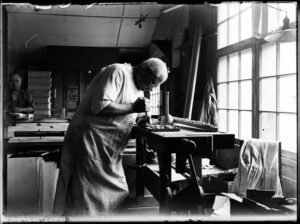
But perhaps most importantly, the Bomans helped create the ecosystem from which later Finnish design legends would emerge.
Before there was Artek, before Tynell’s international success, before the golden age of Finnish design in the 1950s, there were companies like Boman that had already spent decades developing skilled craftsmen, production infrastructure, international networks, and an appreciation for quality design.
In many ways, the Boman story mirrors the story of Finland itself: a small nation striving for recognition through quality, innovation, and craftsmanship.
The company ultimately struggled in the post-war era. What had once been its greatest strength—small production runs, exceptional materials, and uncompromising quality—became increasingly difficult to sustain in a market moving toward mass production. The company was sold in 1955, and furniture production ceased entirely in 1967.
Yet the legacy remains.
Today, collectors often encounter Carl-Johan Boman furniture without realizing the remarkable family story behind it. Every curved sofa, lounge chair, and cabinet represents not only a beautiful object, but a chapter in the history of Finnish design itself.
The Bomans did not merely manufacture furniture.
They helped build an industry.
Nikolai Boman’s story is an important chapter in the broader history of Finnish design. To see how that legacy evolved in the twentieth century, explore our article on Alvar and Aino Aalto: “Two Singular Minds, One Shared Love For Modernism“.
Author: Elias Haddadin
Sources & Further Reading
• Mäkikalli, Marja. Boman, moderni ja suomalaisen huonekalutaiteen murros. Doctoral Dissertation, University of Turku, 2020.
• Bukowskis. Carl Johan Boman, Sideboard, 1930s. Specialist essay and biography. Available at:https://www.bukowskis.com/en/news/1286
• Carl-Johan Boman. Finnish Wikipedia. Available at: https://fi.wikipedia.org/wiki/Carl-Johan_Boman
• Nikolaï Boman. French Wikipedia. Available at: https://fr.wikipedia.org/wiki/Nikola%C3%AF_Boman
• Incollect. Boman Oy – Finnish Mid-Century Modern Furniture Maker. Available at: https://www.incollect.com/artists/boman-oy
