

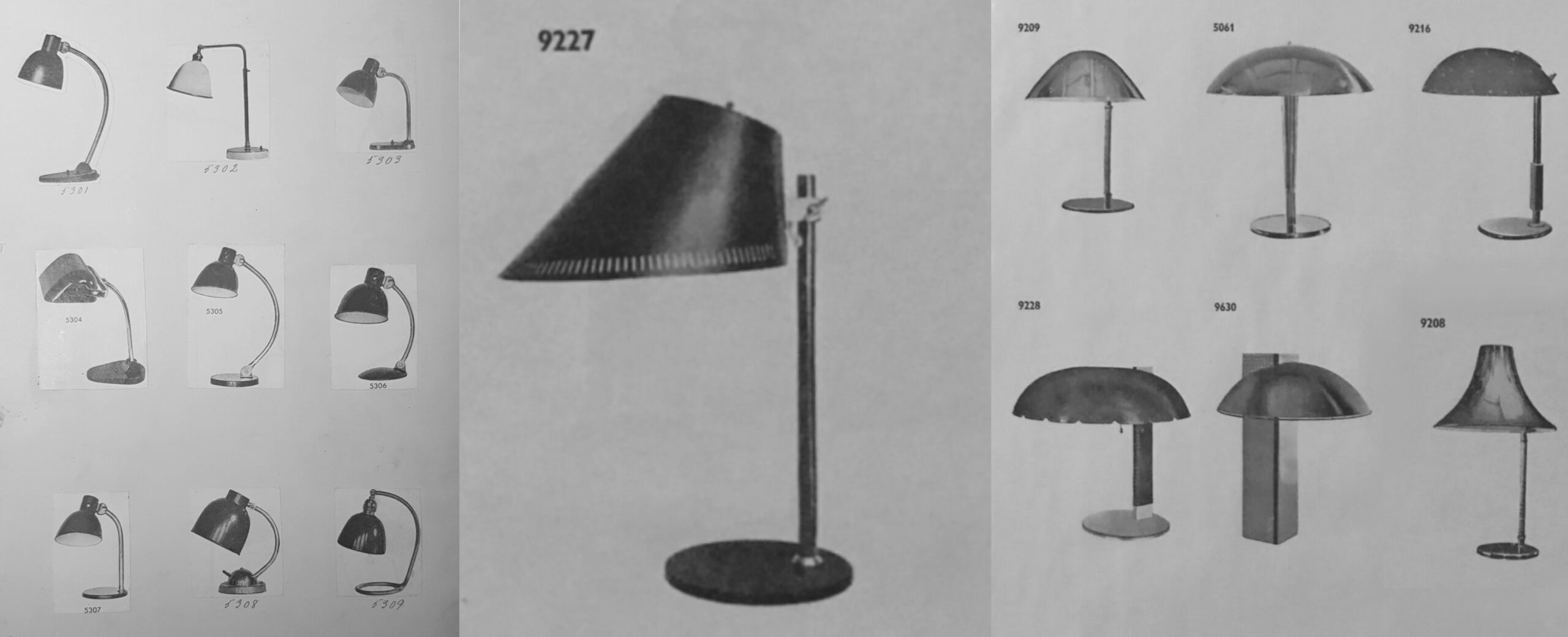
The Tynell 9227 or as I call it, the da Vinci lamp
I believe that if Leonardo da Vinci had ever designed a table lamp, it would come closer to Paavo Tynell’s model 9227 than to almost any other lamp of the twentieth century. Not because of ornament or extravagance, but because of shared principles: function before expression, clarity of purpose, and proportional harmony.
The Tynell 9227 desk/task lamp is one of the longest-produced and most successful lamps in the history of Taito and later Idman. Its longevity is not accidental. It is the result of a design that solved a problem so well that it required little reinvention. To understand why, it is worth examining the lamp through its essential qualities.
1. Functionality
The 9227 was conceived explicitly as a task lamp, a working tool rather than a decorative object. Every design decision serves this function.
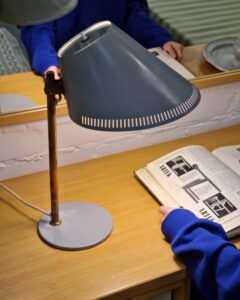
The lamp stands at an optimal distance from the work surface, allowing light to fall naturally onto a desk or table without glare. The proportions of the arm and shade create a comfortable working geometry: close enough to be effective, far enough to avoid obstruction.
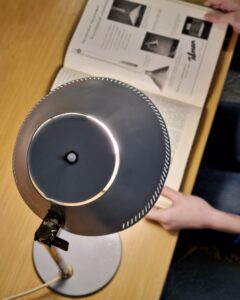
The widening visor is not merely a visual feature. Its flared form spreads and reflects light evenly across a broad working area, reducing harsh contrasts and shadows. This makes the lamp particularly effective for reading, writing, or detailed work.
Crucially, the visor is adjustable. This allows the direction of light to be shifted precisely where it is needed, reinforcing the lamp’s role as an active tool rather than a passive source of illumination.
2. Durability & Construction
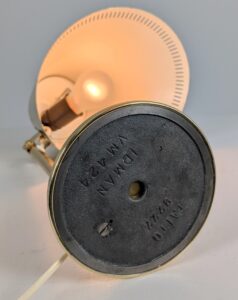
The 9227 was built to endure daily use. It was produced in solid brass as well as painted aluminium, using materials chosen for strength, stability, and longevity. The foot is either solid brass or brass covered heavy iron ensuring further stability.
Surviving examples often remain fully functional after decades, requiring little more than basic maintenance. The mechanical parts are simple and robust, avoiding unnecessary complexity that could compromise reliability. This durability is a key reason the lamp remained in production for such a long period and continues to be used today.

3. A Transitional Design in Tynell’s Work
From a historical perspective, the 9227 occupies an important place in Paavo Tynell’s design evolution.
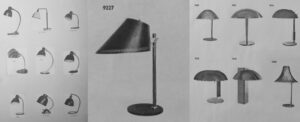
It acts as a visible link between his earlier, more Bauhaus-influenced functionalist lamps and the later, highly decorative perforated brass designs for which he is widely known. In the 9227, restraint and expression coexist. It bridges two periods and two styles without fully belonging to either, making it a crucial transitional object in Tynell’s oeuvre.
4. Modernism & Minimalism
Because functionality was the starting line, the decorative elements stayed at a minimum and the result brought a form that reflects modernist principles: clarity, reduction, and purpose.
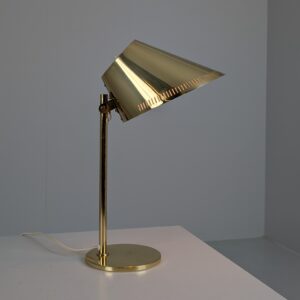
The perforation or detailing is restrained and controlled, serving either light diffusion or visual balance rather than ornament for its own sake. This restraint allowed the lamp to remain relevant even as tastes shifted across decades, standing comfortably alongside other mid century modern designs without appearing dated.
5. Simplicity Without Excess
The 9227 is fundamentally simple. It contains nothing unnecessary, no superfluous curves and no decorative flourishes detached from purpose.
This simplicity is not austerity but discipline. Every element has a reason to exist. The result is a lamp that feels calm, intelligible, and quietly elegant, capable of integrating into a wide range of interiors without dominating them.
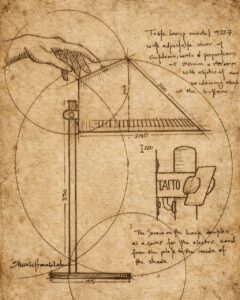
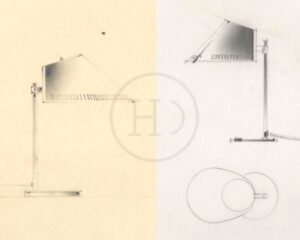
 Original 9227 sketches from the Architectural and Design Museum Archives, Helsinki.
6. Proportion and Visual Harmony
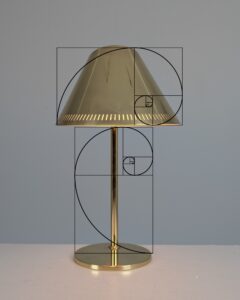
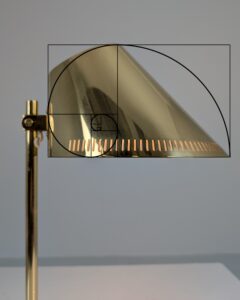
While there are no definitive documentations or drawings proving that the 9227 was mathematically designed according to the golden ratio or Fibonacci sequence, which Tynell often used in his perforations, the lamp exhibits a strong sense of proportional balance consistent with classical design principles.
The relationship between the shade, arm, and base creates a visual harmony that feels stable and natural to the eye. This kind of proportional clarity was central to both modernist design thinking and much older traditions of form-making.
This is where the comparison to Leonardo da Vinci becomes relevant, not as a stylistic link, but as a shared philosophy.
Leonardo viewed machines, tools, and structures as extensions of natural law. In his notebooks, proportion was not decoration but a means of achieving efficiency, balance, and clarity. Forms were shaped by purpose, and beauty emerged because of correctness.
The 9227 follows this same logic. Its visual comfort comes from coherence, not embellishment.
7. Variations and Longevity of Production
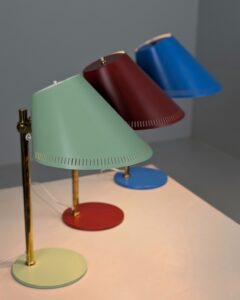
The lamp was produced in full brass, classic black and white, and a range of other colours. This variety allowed it to adapt to different environments—from offices and institutions to private interiors—while maintaining a consistent identity.
These variations also contributed to its collectability. Despite differences in finish, the underlying design remained unchanged, reinforcing the strength of the original concept.
Ultimately, the Paavo Tynell 9227 is not iconic because it is dramatic or ornamental. It is iconic because it is correct.
It solves a practical problem with clarity, durability, and proportional intelligence. Its form is the direct outcome of its function, refined just enough to achieve elegance without excess. This is precisely the kind of object Leonardo da Vinci admired: a tool shaped by necessity, governed by proportion, and perfected through restraint.
In that sense, the 9227 is more than a lamp. It is a reminder that the most enduring designs are often the quiet ones; those that work so well we stop noticing them, even as we continue to use them, decade after decade.
Author: Shadi Haddadin
